The Story Behind the Early Bronco
From a compact idea aimed squarely at the Jeep to one of the most enduring silhouettes in American motoring. The 1966 to 1977 Bronco, considered properly.
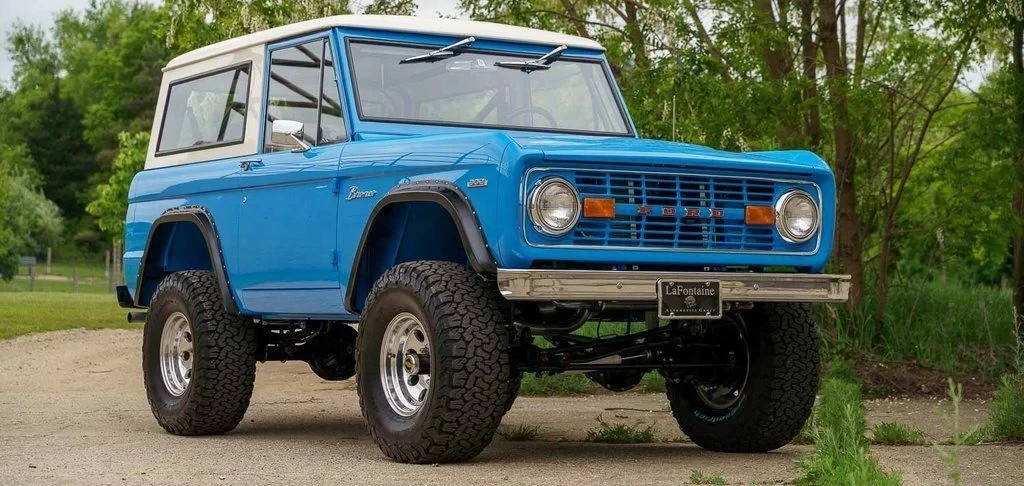
Ford introduced the Bronco in August 1965 as a 1966 model, and it was conceived with unusual clarity: a compact four wheel drive vehicle that would take the Jeep CJ and the International Scout seriously, without borrowing a single body panel from anything else Ford built.
Product manager Donald Frey championed it and Lee Iacocca approved it, with the engineering led by Paul Axelrad. The specification was deliberately clean. A 92 inch wheelbase, a boxed frame, a front suspension using coil springs and radius arms rather than the leaf springs of its rivals, and a recirculating ball steering box. The coil sprung front end gave the Bronco a turning circle and a ride quality its competitors could not match, and it is the single engineering decision that most defines how the vehicle drives.
Three bodies, one idea
Ford offered the Bronco in three forms. The wagon with a full roof, the half cab pickup with a short rear bed, and the roadster with no doors and no roof at all. The roadster sold in tiny numbers and was gone by 1968, which is precisely why it is now the most collectible of the three. The wagon accounted for the overwhelming majority of production and is the shape that defines the model in the public mind.
Engines began with a 170 cubic inch straight six, with a 289 V8 arriving as an option during the first year and growing to 302 for 1969. The 200 cubic inch six replaced the 170 in 1973, the same year an automatic transmission and power steering finally became available. Those 1973 onward cars are the most usable early Broncos, and for a buyer who intends to drive rather than display, that matters.
Why the shape refuses to date
The early Bronco is short, upright and almost entirely without decoration. Flat glass, a plain grille, exposed hinges and a wheel at each corner. Nothing about it was styled for fashion, which is exactly why fashion has never left it behind. Ford's own 2021 revival leaned heavily on this generation, and the effect has been to push original values higher rather than to satisfy demand.
Ford built the first Bronco short, narrow and stubborn. Half a century later that is precisely why people want one.
Uncut, and why the word carries a premium
From the 1970s onward a great many Broncos had their wheel arches cut for larger tyres. An uncut vehicle, with original factory arch profiles and untouched inner wings, is now materially more valuable than a cut one in otherwise identical condition. Reproduction panels exist and the repair can be done well, but the market pays for the original metal and it is right to do so.
- Check the rear quarters, the tailgate, the floors under the seats and the rear crossmember, which is where the frame most commonly fails.
- Look for cut arches, filled holes from removed accessories, and mismatched panel gaps at the doors.
- Confirm the drivetrain is period correct. Later engine swaps are common and affect value even when well executed.
- Inspect the radius arm mounts and the C bushings at the frame, which take considerable load and are frequently tired.
Living with one in Britain
The Bronco is compact by American standards, which makes it far easier on British roads than most of what we import. At just under 152 inches long it is shorter than a modern estate car. Parts support is exceptional, with almost every panel and mechanical component reproduced to a high standard. Vehicles from 1966 to 1985 fall within the rolling forty year historic exemption for UK road tax and MOT, and an early Bronco in good order is a genuinely practical thing to own rather than an indulgence that lives under a cover.
Written by The Stateside Collection. If you would like to discuss a vehicle, or you are looking for something specific, please get in touch or view the collection.