The Rise of the Square Body Chevrolet
Overlooked for years in favour of earlier trucks, the 1973 to 1987 Chevrolet has quietly become one of the most sought after American classics of the decade.
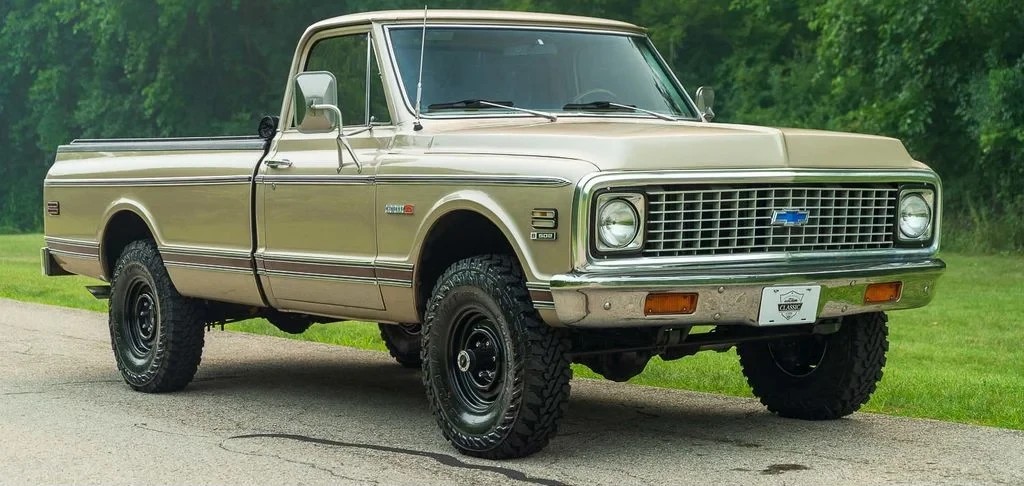
For most of the last thirty years the square body Chevrolet was simply a working truck that had not yet become old enough to be interesting. It is interesting now, and the reasons are more considered than nostalgia.
General Motors launched the third generation C and K series in 1973 and kept the shape in production, with revisions, until 1987. Enthusiasts call it the square body because of what the designers achieved: a cab built from long flat surfaces, a shoulder line that runs uninterrupted from the front wing to the tailgate, and glass area far larger than anything Chevrolet had offered before. It was a rational design at a time when American styling was becoming anything but.
Why the shape has aged so well
Restraint. The proportions are honest and the detailing is minimal, so the truck reads cleanly at any size and in almost any colour. Two tone paint schemes from the period, particularly the Cheyenne and Silverado trims with their bright body side mouldings and wood grain dash inserts, sit comfortably alongside contemporary design rather than fighting it. Park one outside a modern building and it looks deliberate. That is rare in a fifty year old vehicle.
The cab also happens to be a genuinely pleasant place to sit. Chevrolet widened the interior, improved the seating position and made a real effort with ventilation and noise. Compared with the 1967 to 1972 trucks that preceded it, the square body is the first Chevrolet pickup that a modern driver steps into and immediately understands.
Reading the trim and drivetrain codes
Nomenclature is straightforward once decoded. C denotes two wheel drive, K denotes four wheel drive. The number indicates load rating: 10 for half ton, 20 for three quarter ton, 30 for one ton. Trim ran from the plain Custom Deluxe through Scottsdale, Cheyenne and, from 1975, the top Silverado package. A K10 Cheyenne short bed is therefore a half ton, four wheel drive, upper mid trim truck on the shorter wheelbase, and it is the specification most collectors now want.
- Short bed on the 117.5 inch wheelbase is materially more desirable than the long bed, both visually and commercially.
- Small block V8 engines, the 350 in particular, are the sweet spot for usability, parts availability and value.
- Square headlamp trucks from 1981 onward brought lighter bodies and better aerodynamics, while round headlamp trucks up to 1980 carry the earlier, more sought after face.
- Factory air conditioning, gauge packages and the wood grain dash trim all add meaningfully to a considered example.
What to inspect before anything else
Cab corners and the lower rear cab panel are the classic failure points, followed by the front of the bed sides, the inner wings ahead of the doors, and the frame where the rear cab mounts pass through. On four wheel drive trucks check the front differential housing and the condition of the transfer case linkage. Mechanically these trucks are simple and well supported, so the body and frame are what determine whether an example is worth pursuing.
The mechanical parts are a shopping list. The bodyshell is the vehicle.
The market, honestly assessed
Values climbed sharply through the early 2020s as the generation who grew up around these trucks reached the point of buying them, and as the earlier 1967 to 1972 trucks moved beyond comfortable reach. That rise has since steadied. What has not changed is the spread between an ordinary truck and an exceptional one. A tidy driver and a genuinely original, rust free, correctly specified example are separated by a considerable sum, and the gap continues to widen because the supply of the latter only ever decreases.
For a UK buyer the practical case is strong. Parts are inexpensive and available by the container load, the mechanicals are within the reach of any competent independent workshop, and vehicles built before 1 January 1986 are currently exempt from UK road tax and MOT testing under the rolling forty year historic vehicle rules, though owners remain responsible for keeping them roadworthy. Few classics of this presence are as straightforward to live with.
Written by The Stateside Collection. If you would like to discuss a vehicle, or you are looking for something specific, please get in touch or view the collection.